
What's Hiding Beyond Tokyo's Tourist Map?
Note: This article contains affiliate links that support my independent reporting.
What's Hiding Beyond Tokyo's Tourist Map?
What can I say about Tokyo that hasn't already been said? It's the dynamic center of creativity, but for me, the real magic isn't found in the famous tourist circuits like Ueno or Shibuya. It is found on the southern edge of the city: Ota Ward.
Located about 14 kilometers from central Tokyo, this area offers a proximity between modernity and tradition that is rare even for Japan. I based myself in Chidoricho, a quiet neighborhood that sits right between our two destinations: the sacred grounds of Ikegami and the neon pulse of Kamata.
The Quiet Before the Storm
Ikegami Honmonji is not just another temple. Founded in 1282, it is the sacred site where Nichiren, the founder of the Nichiren sect of Buddhism, passed away. Walking the grounds gives you an immediate sense of silence. The architecture transports you back four centuries.
The main hall dates to 1788. Look up and you'll see an immense thatched roof—dry straw layered over a wooden frame using techniques perfected centuries ago, curving upward at the corners in that unmistakable Edo-period aesthetic. Gold-leaf dragons twist beneath the eaves. The towering wooden gate frames the view of the courtyard beyond.
When I visited, the grounds were nearly empty. Clear sky, soft clouds, the kind of stillness that makes you lower your voice without thinking.
But I knew what was coming.
The Oeshiki Festival runs late into the night. Staying nearby means walking home through quiet streets instead of fighting for the last train.
When the Silence Breaks
If you can, time your visit for October.
The Oeshiki Festival commemorates the death of Nichiren, but the atmosphere is anything but somber. It is a massive celebration of life—and it transforms these quiet temple grounds into something unrecognizable.
Thousands fill the courtyard. Groups in traditional happi coats march in procession. The Mando appear—towering lantern floats covered in hundreds of white paper flowers that glow like cherry blossoms from within, swaying dangerously as the carriers dance. Men spin Matoi, heavy fireman standards with long flowing streamers, whipping them aggressively to the beat.
And the beat is relentless. Handheld drums pound in a trance-like rhythm. Flutes cut through the air. The chanting rises. Smoke and motion blur together until you lose track of where the crowd ends and the procession begins.
This is the Japan that doesn't make the guidebooks. Sacred ground turned upside down, silence replaced by thunder, stillness consumed by chaos. And somehow, both versions of this place feel equally true.

Kamata After Dark
After the festival, I took the subway three minutes to Kamata.
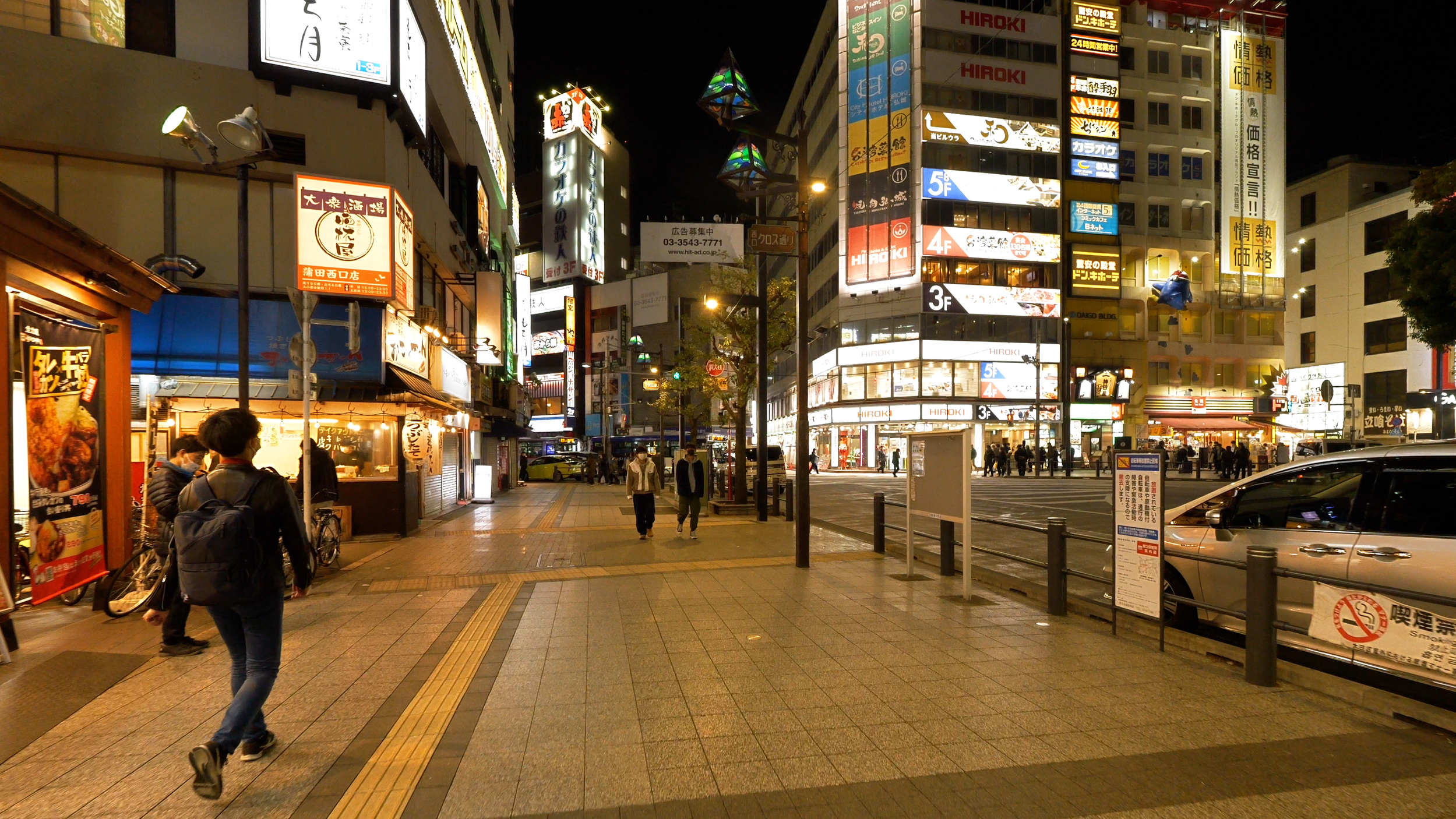
As the sun sets, the Sunroad arcade and surrounding alleyways flicker to life. Neon signage. Charcoal smoke. The narrow lanes of Bourbon Road lined with tiny izakayas, red paper lanterns glowing from every shop front.
Kamata has a shitamachi feel—unpretentious, friendly, deeply local. People sit on milk crates and small stools outside, eating yakitori and drinking beer. The space is tight and intimate. Clinking glasses, laughter, steam rising from food stalls. Salarymen loosen their ties. Locals catch up over small plates.
This isn't the Tokyo you see on Instagram. It's the Tokyo where people actually live.
The Synthesis
I rode a quiet train home that night, the festival noise replaced by the soft hum of the tracks.
Kamata and Ikegami offer something rare: ancient history and modern life existing not in opposition, but in conversation. The prayers and the parties. The silence and the drums. The sacred and the everyday, separated by a three-minute subway ride.
Ota Ward proves that the soul of Tokyo is found in its quiet corners—and in the moments when those corners erupt into something unforgettable.
The Oeshiki Festival: When the Silence Breaks If you can, time your visit for October.
This is when the silence of the temple grounds is replaced by the thunder of Taiko drums and the melody of flutes for the Oeshiki Festival. This event commemorates the death of Nichiren, but the vibe is anything but somber. It is a massive celebration of life.
The highlight is the procession of the Mando ("ten thousand lights")—elaborate lantern floats adorned with paper cherry blossoms. Watching the Matoi (fireman standard bearers) spin their standards to the rhythm of the drums is an experience that stays with you forever.