
The Golden Hour at Senso-ji: Why You Need to Arrive by 7 AM
Note: This article contains affiliate links that support my independent reporting.
Asakusa Before the Crowds
I thrive on the electric hum of a city. Give me the chaotic scramble of Shibuya Crossing or the relentless neon of Kabukicho, and I feel alive. But every urbanist has a breaking point. You cannot survive Tokyo on adrenaline alone. You need balance.
It is just after 7:00 AM on a Tuesday. I am standing in the middle of Asakusa—usually a churning sea of tourists, rickshaws, and selfie sticks. Right now, it is dead silent.
Arriving at Sensoji before the crowds means staying nearby the night before. Rakuten Travel has the largest selection of hotels and ryokans in Japan—including smaller properties not listed on Western booking sites.
The Backstage City
This is not about beating the crowds, though that is a perk. It is about catching the city in its most honest state.
The Sumida River reflects the morning sky. The Tokyo Skytree rises in the distance, sharp against the blue. But down here, at street level, the scene is quieter. A shopkeeper in an apron splashes water on the pavement. Delivery workers in blue uniforms stack red crates. A man on a bicycle rings his bell as he navigates the empty pedestrian path.
I walk through Nakamise shopping street before the shops open. The metal shutters are still down, revealing painted murals that are hidden during the day—artwork most visitors never see because they arrive too late. The old wooden temple gate frames a view of the futuristic gold-glass Asahi Beer Hall behind it. Old and new, not in conflict, but in conversation.
This is the Tokyo that exists before the city puts on its public face.
When the Silence Breaks
By midday, the calm has evaporated.
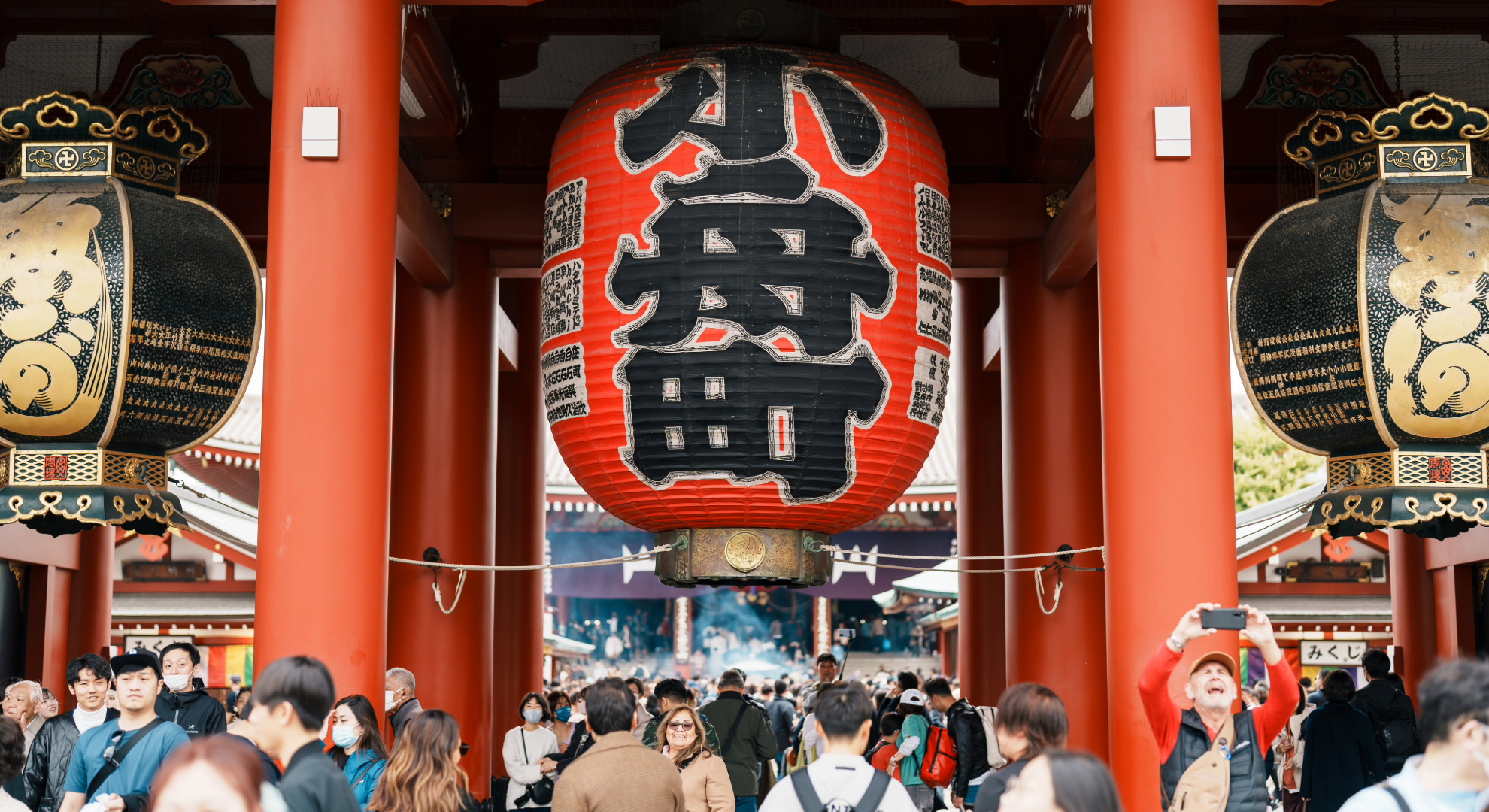
The sun is high and bright. The Sensoji Temple main hall—massive, vermillion, ancient—is now swarming with people. Crowds gather around the incense burner, waving smoke onto themselves for good luck. A traditional wedding couple in kimonos rides past in a black rickshaw, waving at cameras. The shopping street becomes a sea of heads, packed shoulder-to-shoulder.
This is the Asakusa most people know. The postcard version. It is beautiful in its own way—the energy, the color, the sheer density of human life converging on one sacred spot. But it is not the same place I stood in at 7:00 AM.
The Night Shift
As the sky turns dark, the neighborhood transforms again.
Paper lanterns flicker on—hundreds of them, white and red, lining the streets and temple grounds. Hoppy Street fills with people crowding tiny tables, drinking and eating under the glow. The formal reverence of the temple gives way to something looser, more joyful.
I stumble into a scene I wasn't expecting. On a sidewalk outside a shop, a father dressed as a samurai is play-fighting his two young sons, both in ninja costumes. Toy swords clash. The kids strike dramatic poses, shouting with each swing. Passersby stop to watch. Everyone is smiling.
You don't plan for moments like this. You just walk into them.
The Festival I Didn't Know Was Happening
Then the drums start.
Awa Odori dancers appear in matching white and red happi coats, straw hats pulled low. They move in synchronized rows, hands held high, feet shuffling in that distinctive rhythm. Flutes and bells cut through the night air. The crowd claps along—tourists and locals mixed together, nobody trying to be anywhere else.
I came to Asakusa for the quiet morning. I stayed for the chaos of the night. Both versions of this place are real. Both are worth the trip.
The lanterns blur as I walk away. The festival music fades behind me. Somewhere in the distance, a train rattles toward the next station.
Asakusa gave me exactly what I needed—silence at dawn, spectacle at dusk, and everything in between.
Recreate this Trip
🏨 The Stay:
Richmond Hotel Premier
(Right above the temple grounds)
🏮 The Experience:
Asakusa Rickshaw Tour
(See the historic side)
📶 The Data:
Airalo eSIM
(Essential for maps)